Best High-Yield Savings Accounts in 2026: A Beginner-Friendly Guide to Earning More on Your Cash
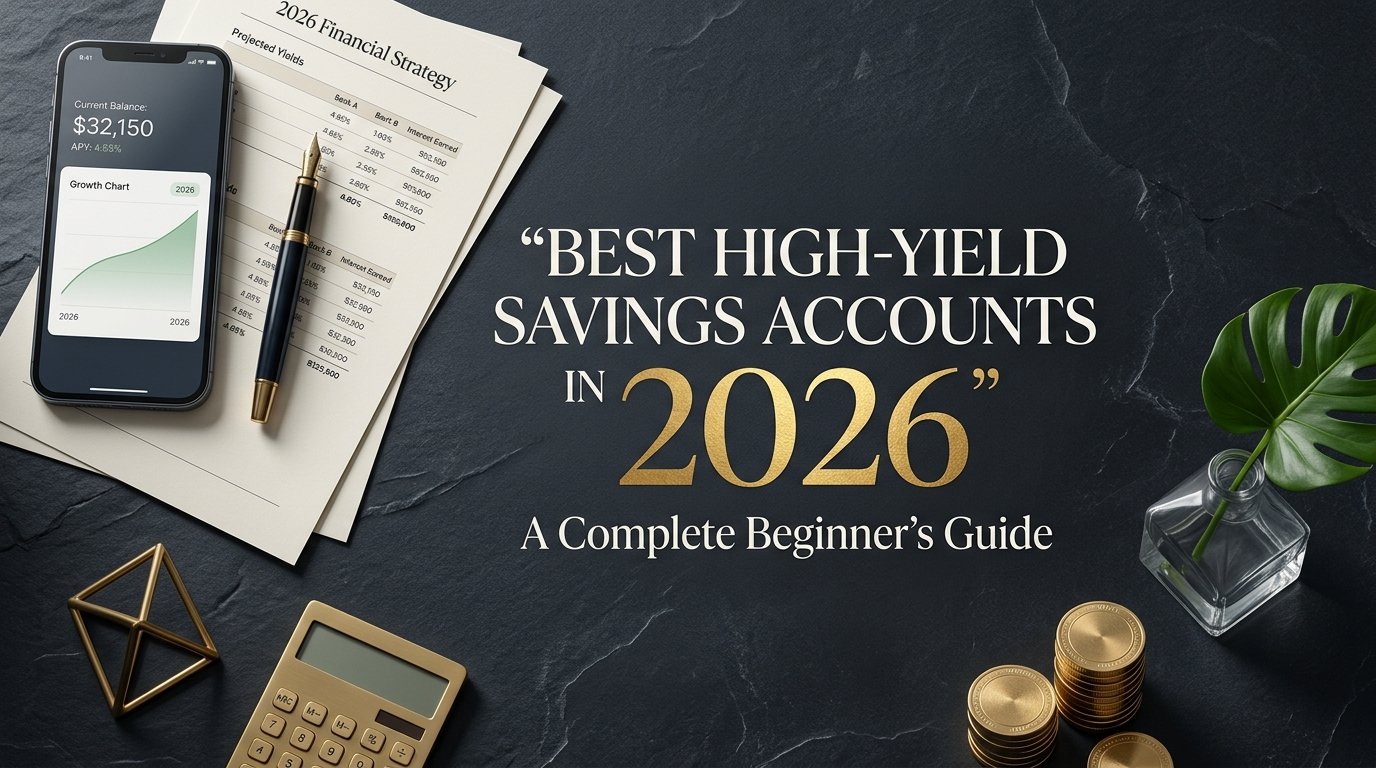
If your savings are sitting in a traditional bank account earning very little interest, you may be leaving money on the table.
A high-yield savings account (HYSA) can help your cash earn more interest while keeping it relatively accessible. The key is choosing an account based on more than just the biggest advertised rate.
In this guide, we’ll look at how best high-yield savings accounts in 2026 work, what to compare, where these accounts fit into your financial plan, and the mistakes worth avoiding.
Important: Savings rates can change at any time. Always verify the current APY, fees, minimum requirements, withdrawal rules, and insurance status directly with the financial institution before opening an account.
What Is a High-Yield Savings Account?
A high-yield savings account is a savings account that generally pays a higher annual percentage yield (APY) than a standard savings account.
APY represents the amount you could earn over one year from interest, assuming the stated rate and compounding conditions remain unchanged.
Unlike investing in stocks or ETFs, you’re not buying market investments when you put money into a savings account. You’re depositing cash with a bank or credit union under the account’s terms.
That makes a HYSA particularly useful for money you may need relatively soon.
What Can You Use a HYSA For?
A high-yield savings account can be a good place for:
- An emergency fund
- A future car or home down payment
- Vacation savings
- A large upcoming purchase
- Short-term financial goals
- Cash you don’t want exposed to stock-market volatility
It generally isn’t designed to replace long-term investments such as diversified stock or bond funds.
Best High-Yield Savings Accounts in 2026: What Should You Compare?
There isn’t one account that’s automatically best for everyone.
The right choice depends on the interest rate, fees, accessibility, minimum requirements, insurance coverage, and features you actually need.
Recent 2026 comparisons show that competitive HYSAs can offer substantially higher yields than many traditional savings accounts, but rates and account terms vary. Some advertised rates also apply only to specific balance tiers or requirements.
Here are the factors I’d check before opening an account.
1. APY
APY is one of the first numbers you’ll notice.
A higher APY can mean more interest on your savings, but don’t look at the rate in isolation.
Ask:
- Is the rate available on my entire balance?
- Is there a minimum deposit?
- Is there a maximum balance that earns the advertised rate?
- Can the bank change the rate?
- Are there promotional conditions?
Savings-account rates are generally variable, meaning the rate can change over time.
2. Monthly Fees
A high interest rate doesn’t help much if recurring fees eat away at your earnings.
Look for accounts with:
- No monthly maintenance fee
- No unnecessary account fees
- Reasonable transfer policies
- Clear fee disclosures
A fee-free account can sometimes be more attractive than an account with a slightly higher APY but expensive requirements.
3. Minimum Balance Requirements
Some accounts require you to maintain a certain balance to earn the advertised APY.
For example, imagine two hypothetical accounts:
| Account | APY | Minimum for advertised rate | Monthly fee |
|---|---|---|---|
| Account A | 4.00% | $0 | $0 |
| Account B | 4.25% | $10,000 | $0 |
If you only have $3,000 available to save, Account B’s headline rate may not actually be available to you.
Always read the rate requirements before comparing accounts.
4. Deposit Insurance
For U.S. savers, federal deposit insurance is an important consideration.
The FDIC’s standard insurance amount is $250,000 per depositor, per insured bank, for each ownership category, subject to applicable rules.
Credit unions generally have comparable federal insurance through the NCUA, although the institution and insurance system are different.
Before depositing a large amount, verify that the institution and account are actually covered.
5. Access to Your Money
A savings account should make it reasonably practical to access your cash when you need it.
Check:
- How quickly transfers arrive
- Whether the bank has branches
- ATM availability
- Mobile-app functionality
- Transfer limits
- External bank transfer options
- Any withdrawal restrictions or fees
This matters especially for an emergency fund.
The highest APY isn’t necessarily the best choice if accessing your money becomes frustrating when you actually need it.
How Much Can You Earn With a High-Yield Savings Account?
Let’s use a simple hypothetical example.
Suppose you keep $10,000 in an account paying a hypothetical 4% APY for one year, and the rate stays unchanged.
You’d earn roughly $400 over a year before taxes, assuming the balance remains around $10,000 and the account’s stated APY applies throughout the period.
That’s not guaranteed because savings rates can change.
The example simply shows why the interest rate can matter when you’re holding substantial amounts of cash.
What About $25,000?
Using the same hypothetical 4% APY:
- $10,000 → approximately $400
- $25,000 → approximately $1,000
- $50,000 → approximately $2,000
These are simplified examples, not promises of future earnings.
If the APY changes during the year or you make deposits and withdrawals, your actual interest will be different.
High-Yield Savings Account vs. Traditional Savings Account
The biggest difference is usually the interest rate.
Traditional savings accounts at large brick-and-mortar banks may offer convenience and branch access, while HYSAs are often offered by online banks or other financial institutions with fewer physical locations.
Here’s a simple comparison:
| Feature | High-Yield Savings | Traditional Savings |
|---|---|---|
| Interest rate | Often higher | Often lower |
| Branch access | Sometimes limited | Often available |
| Liquidity | Generally high | Generally high |
| Market exposure | No | No |
| FDIC/NCUA coverage | Depends on institution | Depends on institution |
| Best use | Savings and cash reserves | General banking and savings |
The important point is that a HYSA is still a savings account.
You’re not accepting stock-market risk simply because the account pays a competitive rate.
HYSA vs. Money Market Account
A money market account (MMA) is another type of deposit account that may offer competitive interest while potentially providing additional features such as checks or debit-card access.
Money market accounts can have different balance requirements, transaction rules, and rates, so compare the actual account terms rather than assuming one option is automatically better.
HYSA vs. Certificate of Deposit
A certificate of deposit (CD) typically requires you to leave your money deposited for a specified period.
In exchange, you may receive a fixed interest rate for that term.
The trade-off is flexibility.
A HYSA generally gives you easier access to your money, while a CD may be useful when you know you won’t need the cash for a specific period and the CD’s terms fit your plan.
HYSA vs. Investing
This is where beginners sometimes get confused.
A high-yield savings account and an investment account serve different purposes.
A HYSA May Be Better For:
- Emergency savings
- Short-term goals
- Money needed within the next few years
- Cash reserves
- Funds you cannot afford to expose to significant market losses
Investing May Be More Appropriate For:
- Long-term wealth building
- Retirement
- Goals that are many years away
- Money you can leave invested through market ups and downs
Stocks and funds can lose value, sometimes substantially.
For long-term goals, however, keeping every dollar in cash also has a downside: inflation can reduce your purchasing power over time.
That’s why many financial plans use both cash savings and long-term investments for different purposes.
How to Choose the Best High-Yield Savings Account for You
Instead of simply searching for the highest APY, use this checklist.
Step 1: Decide What the Money Is For
Start with the goal.
Are you building an emergency fund, saving for a house, or simply looking for a better place to keep excess cash?
Your goal helps determine how much liquidity you need.
Step 2: Calculate Your Target Balance
You don’t necessarily need to move every dollar you own into a HYSA.
For example, you might keep your everyday spending money in checking while maintaining your emergency fund in a separate high-yield savings account.
Step 3: Compare the Full Terms
Look beyond the headline APY.
Check:
- Minimum opening deposit
- Minimum balance
- Monthly fees
- Transfer rules
- Withdrawal restrictions
- ATM access
- Rate tiers
- Promotional rates
- Deposit insurance
Step 4: Verify the Current Rate
Don’t rely on an old comparison article alone.
Savings rates can change, and a rate published several months ago may no longer be available.
Before opening the account, check the financial institution’s current disclosures.
Step 5: Automate Your Savings
Once you’ve chosen an account, automation can make saving much easier.
You could arrange an automatic transfer after each paycheck rather than waiting to see what’s left at the end of the month.
Even relatively small recurring contributions can build a meaningful cash reserve over time.
How Much Should You Keep in a High-Yield Savings Account?
There’s no universal number that works for everyone.
Your ideal emergency-fund size depends on factors such as:
- Monthly essential expenses
- Income stability
- Job security
- Household responsibilities
- Insurance coverage
- Access to other resources
- Upcoming financial obligations
Someone with highly variable income may reasonably want a larger cash reserve than someone with very stable income and predictable expenses.
The goal isn’t to maximize the balance at all costs.
The goal is to keep enough accessible cash to handle realistic financial surprises without immediately relying on expensive debt.
Common Mistakes to Avoid
Chasing Every Small Rate Difference
Switching accounts constantly for a tiny APY difference may not be worth the effort.
For example, on a hypothetical $2,000 balance, a 0.25 percentage-point difference represents only about $5 of additional annual interest before taxes if the rates remain unchanged.
Your time and convenience have value too.
Ignoring Balance Tiers
An account advertising a very high APY may apply that rate only to part of your balance.
Always check the rate structure.
Forgetting About Taxes
For U.S. taxpayers, interest from ordinary bank accounts is generally taxable income.
The IRS explains that interest received or credited to an account and available for withdrawal is generally taxable, subject to applicable exceptions.
Your tax situation may differ, so consider your circumstances and consult a qualified tax professional when appropriate.
Keeping Your Emergency Fund in Stocks
An emergency fund has a different job from a long-term investment portfolio.
If the stock market falls when you suddenly need your money, selling investments could force you to lock in losses.
Keeping emergency savings in an accessible deposit account can reduce that particular risk.
Assuming the Highest APY Is Automatically Best
A high rate is attractive.
But a slightly lower rate with no fees, excellent access, strong customer service, and straightforward terms could be a better fit for your situation.
A Simple HYSA Action Plan for Beginners
If you’re starting from scratch, here’s a practical approach.
- Calculate your essential monthly expenses.
- Set an initial emergency-fund target.
- Compare several HYSAs using APY, fees, access, and insurance.
- Verify the current terms directly with the institution.
- Open the account that fits your needs rather than simply chasing the highest advertised rate.
- Automate regular contributions.
- Review the APY and account terms periodically.
- Keep long-term investment money separate from short-term savings.
This approach is intentionally simple.
You don’t need to constantly move your money around to make meaningful progress.
Are High-Yield Savings Accounts Safe?
A HYSA itself isn’t an investment in the stock market.
However, “safe” should not be interpreted as meaning that every financial product or every institution is automatically protected.
If you’re using a U.S. bank, verify that it is FDIC-insured and understand the applicable coverage limits. For credit unions, check the institution’s NCUA insurance status.
Also be careful when a financial product uses words such as “high yield” but isn’t actually a conventional insured deposit account.
Read the product description carefully.
What Happens When Savings Rates Fall?
This is an important point that often gets overlooked.
HYSAs usually have variable rates, so your APY can fall even if you haven’t changed anything about your account.
That doesn’t automatically mean you chose the wrong account.
It simply means savings rates respond to broader interest-rate conditions and individual institutions can change what they pay.
Instead of obsessing over daily rate movements, focus on whether your account remains competitive and continues to fit your financial needs.
The Bigger Picture: Where a HYSA Fits Into Your Financial Plan
A high-yield savings account is a tool, not a complete financial strategy.
A healthy financial plan may involve several layers:
- Checking account: Everyday spending
- HYSA: Emergency fund and short-term goals
- Retirement account: Long-term retirement investing
- Taxable brokerage account: Additional long-term investing
- Debt repayment: Reducing expensive interest costs
The exact mix depends on your income, goals, debt, taxes, risk tolerance, and time horizon.
The important thing is giving each dollar a job.
Final Thoughts on the Best High-Yield Savings Accounts in 2026
The best high-yield savings accounts in 2026 aren’t necessarily the ones with the flashiest advertised APY.
A good account should offer a competitive rate, reasonable terms, appropriate deposit insurance, low fees, and the level of access you need.
If you’re holding cash for an emergency fund or a short-term goal, comparing HYSAs can be a simple financial improvement worth making.
Before opening an account, verify the current APY and terms directly with the institution. Then automate your savings and let consistency do the heavy lifting.
Your next step: check how much cash you currently have sitting in low-interest accounts, determine what portion belongs in short-term savings, and compare a few current HYSAs using the checklist above.
Disclaimer: This article is for educational and informational purposes only and should not be considered personalized financial, investment, tax, or legal advice. Financial products, rates, fees, insurance coverage, and tax rules can change. Consider your own financial situation and consult a qualified professional when appropriate.